
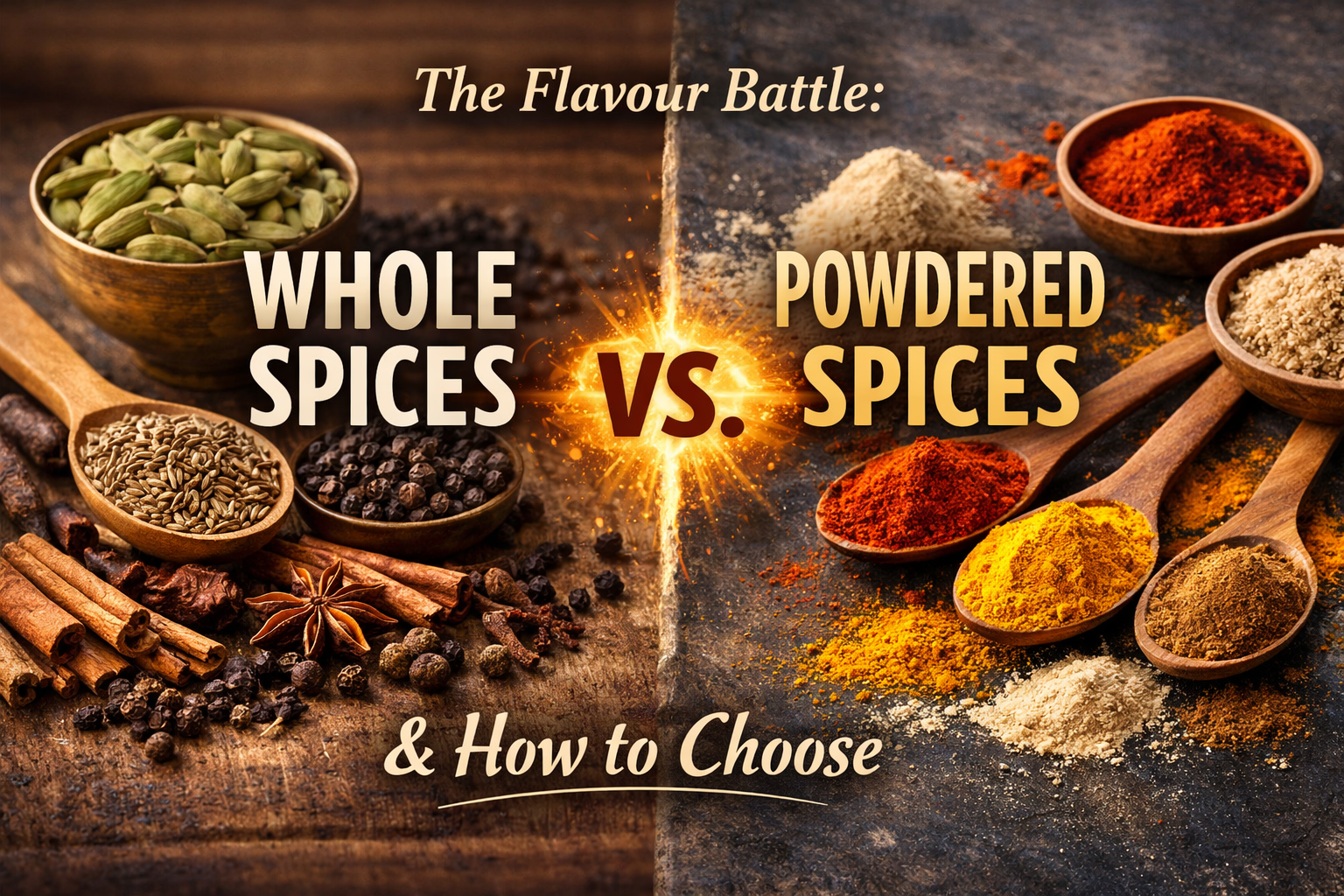
Try to think of a dish that can be differentiated from the common to the exceptional through a special emphasis on spices. For chefs, home cooks, and culinary enthusiasts, the debate over whole spices vs. powdered spices has become a contentious issue and this is in no way a best-versus-worst scenario. Until now, spices have differentiated cuisine styles, optimized fragrances, and maximized the complexity of flavors. Through knowledge on the science of spices, cooking enthusiasts and even health-conscious consumers can take a journey in ensuring that all dishes manifest their ultimate possibility.
Table of Contents
ToggleUnderstanding Spices Beyond the Label
To venture into whole spices vs. powdered spices, it is necessary to describe what spices essentially are. Obtained from the seeds, bark, roots, buds, or even flowers of plants, the primary function of spices is to act as carriers of essential oils that create their flavor and aroma. On the same note, just as the chemical properties influence their performance, the form in which they are present whole or powdered also greatly impacts their performance. Unleash the power of these ingredients as you realize that grinding them leads to an acceleration of the oxidation process, and their whole form shields essential oils.
What Are Whole Spices?
Whole spices can be considered a pot of gold when it comes to retaining their integrity in terms of flavor. Taking into consideration some of the examples outlined, we can see that peppercorns, cloves, cinnamon sticks, cardamoms, and cumin seeds fall under this category. By being encapsulated in their own natural design, essential oils within them stay fresh, providing a potential shelf life of years, which is what makes them a blissful experience for a conscious shopper. In terms of cooking, whole spices prove to be most effective in simmering, tempering, making infusions, and making use of them fresh.
What Are Powdered Spices?
Changing focus, powdered spices are ground spices, essentially processed forms of whole spices. Produced through precise grinding methods, whether in large-scale industrial settings or by home grinding, powdered spices offer instant flavor with unmatched convenience. The days when whole-spice processing for cooking was the only option in busy kitchens are long past; powdered spices make cooking more efficient while still delivering consistent flavor. Commonly used in cooking, baking, and the preparation of spice blends, powdered spices excel in efficiency and ease of use. As a result, they are especially well suited to busy lifestyles, allowing cooks to enjoy rich flavors without compromising on enjoyment.
Flavour Depth and Aroma Where the Real Difference Lies
To say apart from aroma, flavour chemistry demonstrates the real divergence between whole spices vs. powdered spices. By increasing surface area, grinding hastens oxidation and accelerates the loss of volatile substances. As a result, pre-ground spices often lose intensity over time, while freshly ground whole spices release a captivating burst of fragrance. Equally important, this difference affects layering in complex recipes. For example, tempering whole spices in hot oil unleashes nuanced notes, whereas powdered spices integrate faster but subtly. In essence, understanding these sensory dynamics allows cooks to unleash the full potential of their pantry, optimizing taste without compromise.
Convenience vs Control in Everyday Cooking
In embracing the practical aspect, comparison between whole spices vs. powdered spices can be done from the viewpoint of lifestyle. There is no doubt that the powders are convenient and suited for fast food preparation and recipes that need consistency and uniform texture and taste. Conversely, the use of whole spices provides the greatest flexibility for culinary preparation with the ability to regulate the intensity of the dish through the gradual addition of the desired amount of flavor at different intensities. In order to get the most from your culinary experience, there is also the need to assess your style and pace of food preparation.
Nutritional and Purity Considerations
When discussing quality, whole spices and powdered spices differ in terms of nutritional retention and purity. Whole spices retain volatile components for longer periods, which can result in better nutritional integrity and stronger antioxidant properties. On the other hand, powdered forms may be mixed with other substances if they are of lower quality, highlighting the importance of choosing reputable suppliers or grinding spices in-house. Ultimately, whole spices are widely regarded as purer and often provide consumers with greater peace of mind.
When to Choose Whole Spices
There are several considerations when opting for whole spices. Slow-cooked dishes, tempering, and infusions benefit from the gradual release of flavour. Recipes requiring layered taste profiles such as biryanis, stews, or traditional curries, gain depth when whole spices are used. Grinding spices fresh not only enhances aroma but also maximizes control over intensity. By exploring traditional and regional practices, cooks can uncover a plethora of techniques that bring dishes to life. Thus, whole spices are not merely an option, they are essential tools for culinary craftsmanship and authenticity.
When Powdered Spices Make More Sense
On the other hand, the uses of powdered spices are imperative in modern cooking. This is because meal preparations, fast meals, and baked goods are properly treated and supplemented by the efficiency offered by the powdered spices. Again, mixtures of spices, such as those used in preparing meals, require a certain proportion or measurement, which the powder forms provide. In other situations or recipes, if the smell does not have a significant difference, then the efficiency offered by the powder form is imperative. With the adoption of the powder form, consistency in taste can be achieved despite hectic schedules.
The Smart Kitchen Approach Using Both Strategically
The strategy for the smart kitchen In order to gain the final kitchen secret for successful cooking, it would be important to incorporate the concept of whole spices vs. powdered spices. Seasoned chefs mix and match whole spices for their depth of flavor and mix powder spices for an easy blend of flavors and aroma layers. Preparing a pantry of spices in their whole and powdered forms will result in maximum elasticity in cooking and have multiple benefits of being cost-effective and waste-free. A mixture of blending techniques will also encompass creative facets of cooking while ensuring consistency and consistency continues to be the backbone of mastery in cooking techniques.
Final Verdict It’s Not a Battle, It’s a Balance
Whole spices vs. powdered spices , the comparison is not about which is better, but which is needed when and why. Whole spices are all about layer, control, and longevity, whereas powdered spices are all about ease, uniformity, and speed. The key to wisely navigating this continuum is to understand your own cooking methods, the nature of the recipe, and the requirements of your life. The most important thing to keep in mind is that proper use and mix-maximizationare all that stand between you and successful cuisine. The art of knowing both will make every single dish a reflection of art, science, and deliciousness.
Order from Kerala Spices Online today to bring authentic, aromatic spices straight to your kitchen.